All posts by hewlett@uwyo.edu

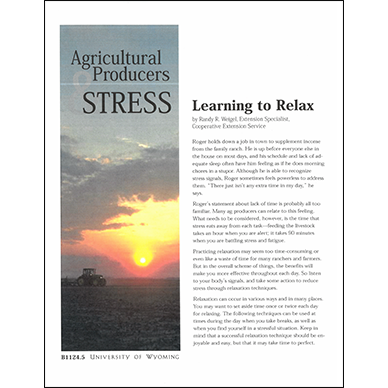
Learning to Relax

AG LEGACY image

#AGLEGACY.org #FarmSuccession #EstatePlanning

Roger holds down a job in town to supplement income from the family ranch. He is up before everyone else in the house on most days, and his schedule and lack of adequate sleep often have him feeling as if he does morning chores in a stupor. Although he is able to recognize stress signals, Roger sometimes feels powerless to address them. “There just isn’t any extra time in my day,” he says.

Practicing relaxation may seem too time-consuming or even like a waste of time for many ranchers and farmers. But in the overall scheme of things, the benefits will make you more effective throughout each day.

AG LEGACY can help…
Check the AG LEGACY Materials tab at AGLEGACY.org
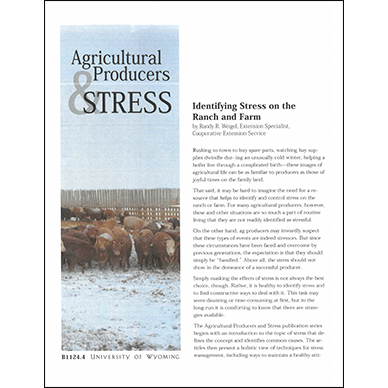
Identifying Stress on the Ranch and Farm

AG LEGACY image

#AGLEGACY.org #FarmSuccession #EstatePlanning

Rushing to town to buy spare parts, watching hay supplies dwindle during an unusually cold winter, helping a heifer live through a complicated birth—these images of agricultural life can be as familiar to producers as those of joyful times on the family land. That said, it may be hard to imagine the need for a resource that helps to identify and control stress on the ranch or farm. For many agricultural producers, however, these and other situations are so much a part of routine living that they are not readily identified as stressful.

Simply hiding the effects of stress is not always the best choice. It is much healthier to identify stress and find constructive ways to deal with it.

AG LEGACY can help…
Check the AG LEGACY Materials tab at AGLEGACY.org
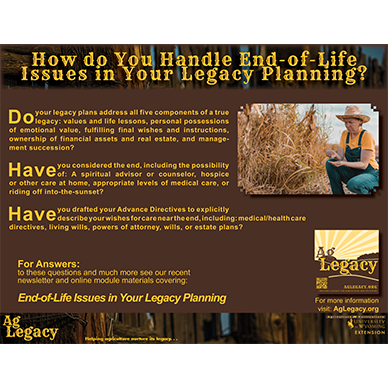
How do You Handle End-of-Life Issues in Your Legacy Planning?

2020_10_06_AgLegacy_AADWSAN_IMAGE
#AGLEGACY.org #FarmSuccession #EstatePlanning

DO your legacy plans address all five components of a true legacy: values and life lessons, personal possessions of emotional value, fulfilling final wishes and instructions, ownership of financial assets and real estate, and management succession?

HAVE you considered the end, including the possibility of: A spiritual advisor or counselor, hospice or other care at home, appropriate levels of medical care, or riding off into-the-sunset?

HAVE you drafted your Advance Directives to explicitly describe your wishes for care near the end, including: medical/health care directives, living wills, powers of attorney, wills, or estate plans?

AG LEGACY Materials can help…
To learn more about AG LEGACY materials and for ideas on where to begin see AGLEGACY.org

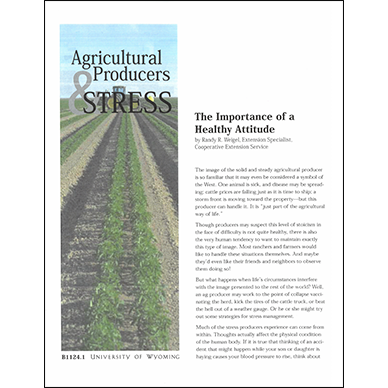
The Importance of a Healthy Attitude

2020_05_28_APS_TOHA_B1124-1_IMAGE

#AGLEGACY.org #FarmSuccession #EstatePlanning

The image of the solid and steady agricultural producer is so familiar that it may even be considered a symbol of the West. One animal is sick, and disease may be spreading; cattle prices are falling just as it is time to ship; a storm front is moving toward the property—but this producer can handle it. It is “just part of the agricultural way of life.”

But what happens when life’s circumstances interfere with the image presented to the rest of the world?

AG LEGACY can help…
Check the AG LEGACY Materials tab at AGLEGACY.org
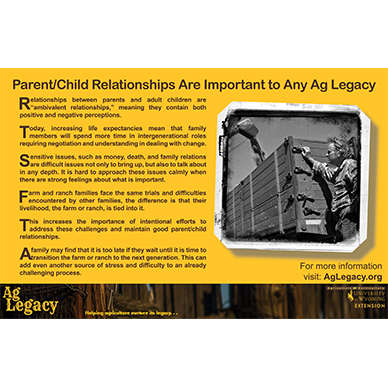
Parent/Child Relationships Are Important to Any Ag Legacy

AGLEGACY POST IMAGE

#AGLEGACY.org #FarmSuccession #EstatePlanning

* Relationships between parents and adult children are “ambivalent relationships,” meaning they contain both positive and negative perceptions.

* Today, increasing life expectancies mean that family members will spend more time in intergenerational roles requiring negotiation and understanding in dealing with change.

* Sensitive issues, such as money, death, and family relations are difficult issues not only to bring up, but also to talk about in any depth. It is hard to approach these issues calmly when there are strong feelings about what is important.

* Farm and ranch families face the same trials and difficulties encountered by other families, the difference is that their livelihood, the farm or ranch, is tied into it.

* This increases the importance of intentional efforts to address these challenges and maintain good parent/child relationships.

* A family may find that it is too late if they wait until it is time to transition the farm or ranch to the next generation. This can add even another source of stress and difficulty to an already challenging process.

AG LEGACY Materials can help understand what your options are. To learn more about AG LEGACY materials and for ideas on where to begin see AGLEGACY.org

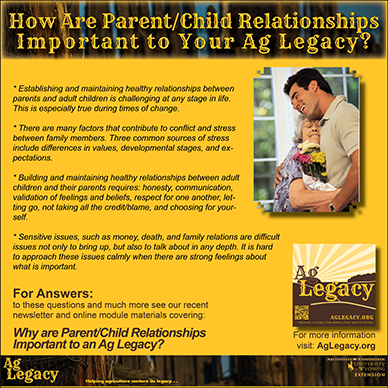
How Are Parent/Child Relationships Important to Your Ag Legacy?

AGLEGACY POST IMAGE

* Establishing and maintaining healthy relationships between parents and adult children is challenging at any stage in life. This is especially true during times of change.

* There are many factors that contribute to conflict and stress between family members. Three common sources of stress include differences in values, developmental stages, and expectations.

* Building and maintaining healthy relationships between adult children and their parents requires: honesty, communication, validation of feelings and beliefs, respect for one another, letting go, not taking all the credit/blame, and choosing for yourself.

* Sensitive issues, such as money, death, and family relations are difficult issues not only to bring up, but also to talk about in any depth. It is hard to approach these issues calmly when there are strong feelings about what is important.

#AGLEGACY.org #FarmSuccession #EstatePlanning

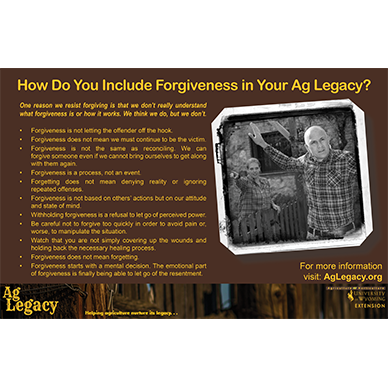
How Do You Include Forgiveness in Your Ag Legacy?

AgLegacy_IMAGE

One reason we resist forgiving is that we don’t really understand what forgiveness is or how it works. We think we do, but we don’t.
* Forgiveness is not letting the offender off the hook.
* Forgiveness does not mean we must continue to be the victim.
* Forgiveness is not the same as reconciling. We can
forgive someone even if we cannot bring ourselves to get along with them again.
* Forgiveness is a process, not an event.
* Forgetting does not mean denying reality or ignoring
repeated offenses.
* Forgiveness is not based on others’ actions but on our attitude and state of mind.
* Withholding forgiveness is a refusal to let go of perceived power.
* Be careful not to forgive too quickly in order to avoid pain or, worse, to manipulate the situation.
* Watch that you are not simply covering up the wounds and holding back the necessary healing process.
* Forgiveness does not mean forgetting.
* Forgiveness starts with a mental decision. The emotional part of forgiveness is finally being able to let go of the resentment.

#AGLEGACY.org #FarmSuccession #EstatePlanning