All posts by hewlett@uwyo.edu

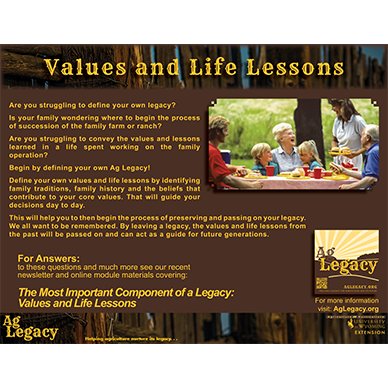
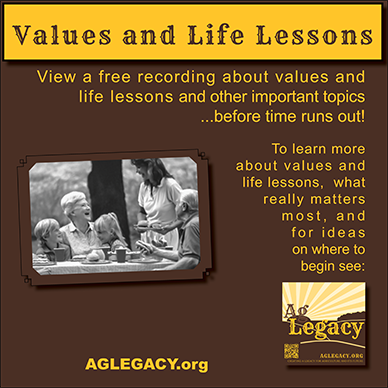
Values and Life Lessons

AG LEGACY image
#AGLEGACY.org #FarmSuccession #EstatePlanning

View a free recording about values and life lessons and other important topics
…before time runs out!

TO LEARN MORE To learn more
about values and life lessons, what really matters most, and for ideas on where to begin see: AGLEGACY.org

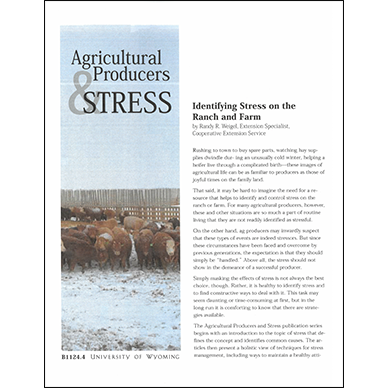
Identifying Stress on the Ranch and Farm

AG LEGACY image

#AGLEGACY.org #FarmSuccession #EstatePlanning

Rushing to town to buy spare parts, watching hay supplies dwindle during an unusually cold winter, helping a heifer live through a complicated birth—these images of agricultural life can be as familiar to producers as those of joyful times on the family land. That said, it may be hard to imagine the need for a resource that helps to identify and control stress on the ranch or farm. For many agricultural producers, however, these and other situations are so much a part of routine living that they are not readily identified as stressful.

Simply hiding the effects of stress is not always the best choice. It is much healthier to identify stress and find constructive ways to deal with it.

AG LEGACY can help…
Check the AG LEGACY Materials tab at AGLEGACY.org

The Most Important Component of a Legacy

AG LEGACY image
#AGLEGACY.org #FarmSuccession #EstatePlanning

Values and life lessons has been identified as the most important component of a complete legacy. This is made up of 3 separate components, including Family Traditions, Family History and Beliefs.

Family traditions consist of religious, cultural and as well as family traditions handed down through generations. Traditions can help families improve communication, learn to value time spent together and celebrate each other’s achievements. All of which can help families get through tough times and changes.

Family histories may not include anyone famous, or infamous. However, they are of great value to the family, no matter what the tale. Many great stories can be found or shared that can bring a family’s history to life. Look for ways to preserve your own and your family’s history through books, audio or video recordings, etc.

Beliefs: A person’s beliefs are very important because those beliefs define the limit of that person’s experience. A person’s belief system is the set of precepts by which they live daily life and that govern their thoughts, words, and actions.

Taken together these create a person’s legacy. When a family identifies these for each other and themselves, they begin to define their own legacy. This legacy can live on and serve as inspiration and guidance for future generations.

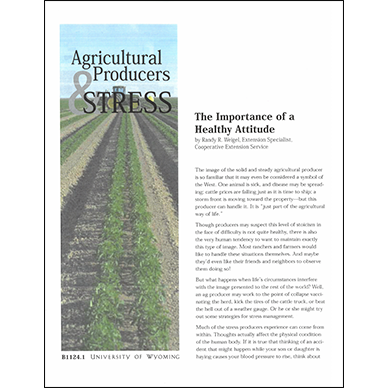
The Importance of a Healthy Attitude

2020_05_28_APS_TOHA_B1124-1_IMAGE

#AGLEGACY.org #FarmSuccession #EstatePlanning

The image of the solid and steady agricultural producer is so familiar that it may even be considered a symbol of the West. One animal is sick, and disease may be spreading; cattle prices are falling just as it is time to ship; a storm front is moving toward the property—but this producer can handle it. It is “just part of the agricultural way of life.”

But what happens when life’s circumstances interfere with the image presented to the rest of the world?

AG LEGACY can help…
Check the AG LEGACY Materials tab at AGLEGACY.org

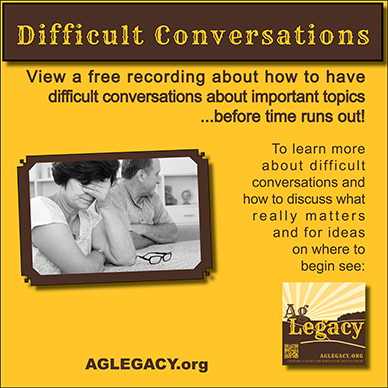
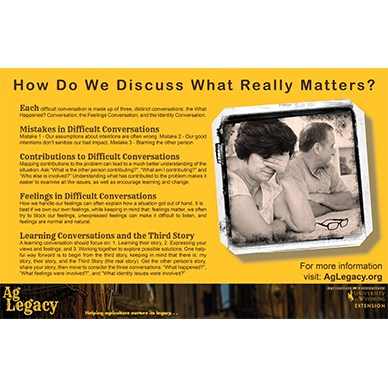
How Do We Discuss What Really Matters?

2020_05_26_DifficultConversations_how_INST_IMAGE
#AGLEGACY.org #FarmSuccession #EstatePlanning

Each difficult conversation is made up of three, distinct conversations: the What Happened? Conversation; the Feelings Conversation; and the Identity Conversation.

Mistakes in Difficult Conversations
Mistake 1 – Our assumptions about intentions are often wrong. Mistake 2 – Our good intentions don’t sanitize our bad impact. Mistake 3 – Blaming the other person.

Contributions to Difficult Conversations
Mapping contributions to the problem can lead to a much better understanding of the situation. Ask “What is the other person contributing?”, “What am I contributing?” and “Who else is involved?” Understanding what has contributed to the problem makes it easier to examine all the issues, as well as encourage learning and change.

Feelings in Difficult Conversations
How we handle our feelings can often explain how a situation got out of hand. It is
best if we own our own feelings, while keeping in mind that: feelings matter, we often try to block our feelings, unexpressed feelings can make it difficult to listen, and feelings are normal and natural.

Learning Conversations and the Third Story
A learning conversation should focus on: 1. Learning their story, 2. Expressing your views and feelings; and 3. Working together to explore possible solutions. One helpful way forward is to begin from the third story, keeping in mind that there is: my story, their story, and the Third Story (the real story). Get the other person’s story, share your story, then move to consider the three conversations: “What happened?”, “What feelings were involved?”, and “What identity issues were involved?”

TO LEARN MORE about difficult conversations and how to discuss what really matters and for ideas on where to begin see: AGLEGACY.org > Modules
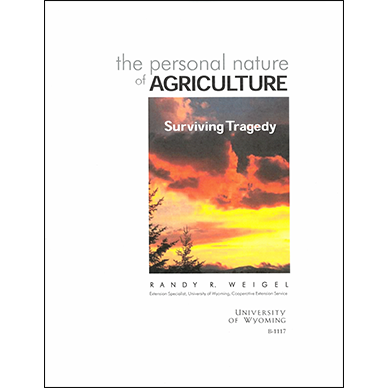
Surviving Tragedy

2020_05_21_PNA_ST_B-1117_IMAGE

#AGLEGACY.org #FarmSuccession #EstatePlanning

Losing a limb, death, divorce, or losing the farm or ranch shapes the lives of ranchers and farmers in long and lasting ways. Much of the study of people’s adaptation to traumatic events focuses on pain and suffering. But in the aftermath of adversity, people often show tenacity and resilience, eventually exhibiting personal growth. Major life crises can be catalysts for personal growth and coping.

Why do life crises lead to greater self-reliance, confidence, and effective coping in some people and yet shatter the lives of others?

AG LEGACY can help…
Check the AG LEGACY Materials tab at AGLEGACY.org

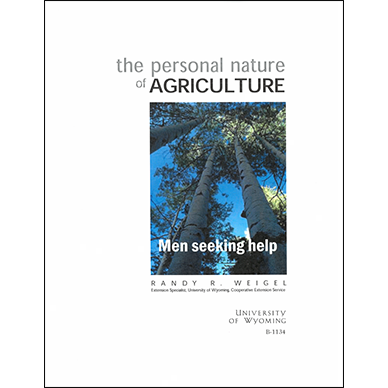
Men Seeking Help

2020_05_14_PNA_MSH_B1134_IMAGE

#AGLEGACY.org #FarmSuccession #EstatePlanning

“Where do cowboys go to cry?” When this question was raised at a recent stress management workshop, an immediate response was “They don’t, and they won’t.”

Although there are many ranch and farm men who seek help when facing personal challenges, there are also those who find it difficult and even refuse to seek help. Why?

Often, a traditional view of being male causes many men to hesitate to seek help from others. For example, some men are taught that masculine power, dominance, competition, and control are essential to proving one’s masculinity; that vulnerabilities, feelings, and emotions in men are signs of femininity and are to be avoided; that masculine control of self, others, and environment are essential for men to feel safe, secure, and comfortable; and that men seeking help and support from others is a sign of weakness, vulnerability, and potential incompetence.

AG LEGACY can help…
Check the AG LEGACY Materials tab at AGLEGACY.org

Difficult Conversations: What Really Matters?

2020_05_12_DifficultConversations_main_INST_IMAGE
#AGLEGACY.org #FarmSuccession #EstatePlanning

* Do you find yourself avoiding difficult conversations?
* Do you assume you know the other person’s intentions when there is a disagreement?
* Do you find that you blame whenever things go wrong?
* Do you consider feelings an important part of a difficult conversation?
* Do you sometimes wonder if you are a good person when someone calls into question your identity in a difficult situation?
* The Third Story describes what really happened. It can only be understood after we understand the other person’s story as well as our own.
* A learning conversation works best when both parties are willing to listen and work together to find a solution.

FOR ANSWERS:
to these questions and much more see our recent newsletter and online module covering: Difficult Conversations: How Do We Discuss What Really Matters? at: AGLEGACY.org > Modules

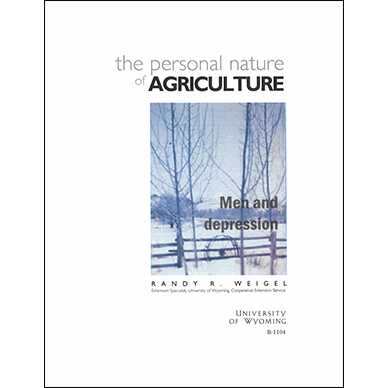
Men and Depression

2020_05_07_PNA_MAD_B1104_IMAGE

#AGLEGACY.org #FarmSuccession #EstatePlanning

“Men would rather kill themselves than admit they are depressed.” This chilling statement illustrates the complexity of male depression.

Depression appears to take a greater toll on men. Although more women attempt suicide, more men actually succeed and commit suicide at four times the rate women do. A recent study found that depressed men were twice as likely as their non-depressed counterparts to develop heart disease or die suddenly because of heart problems.

AG LEGACY can help…
Check the AG LEGACY Materials tab at AGLEGACY.org